Send SIA a coordinate or H3 cell. Get back a safety score, colour index and contribution ledger. The score is composed from available signal layers, not hidden behind a black box. You can see what contributed, which sources were present and how the result should be interpreted.
The customer path is deliberately small: one request in, one explainable result out. The complexity lives behind the API, where SIA resolves place, reads available sources and returns the evidence alongside the score.
Call SIA with a coordinate or an H3 cell. The same contract works from REST, the TypeScript SDK, the CLI and the MCP server.
SIA maps the place to an H3 resolution-8 cell, so every result is tied to a stable area rather than a vague neighbourhood boundary.
The Risk API checks which signal sources are available for that cell and composes the score for the requested intent.
You get a safety score, colour index, contributing sources and the per-source breakdown that explains why the score landed there.
The playground is already live inside the SIA developer platform: choose a region, call the API and inspect scored H3 cells directly on the map.
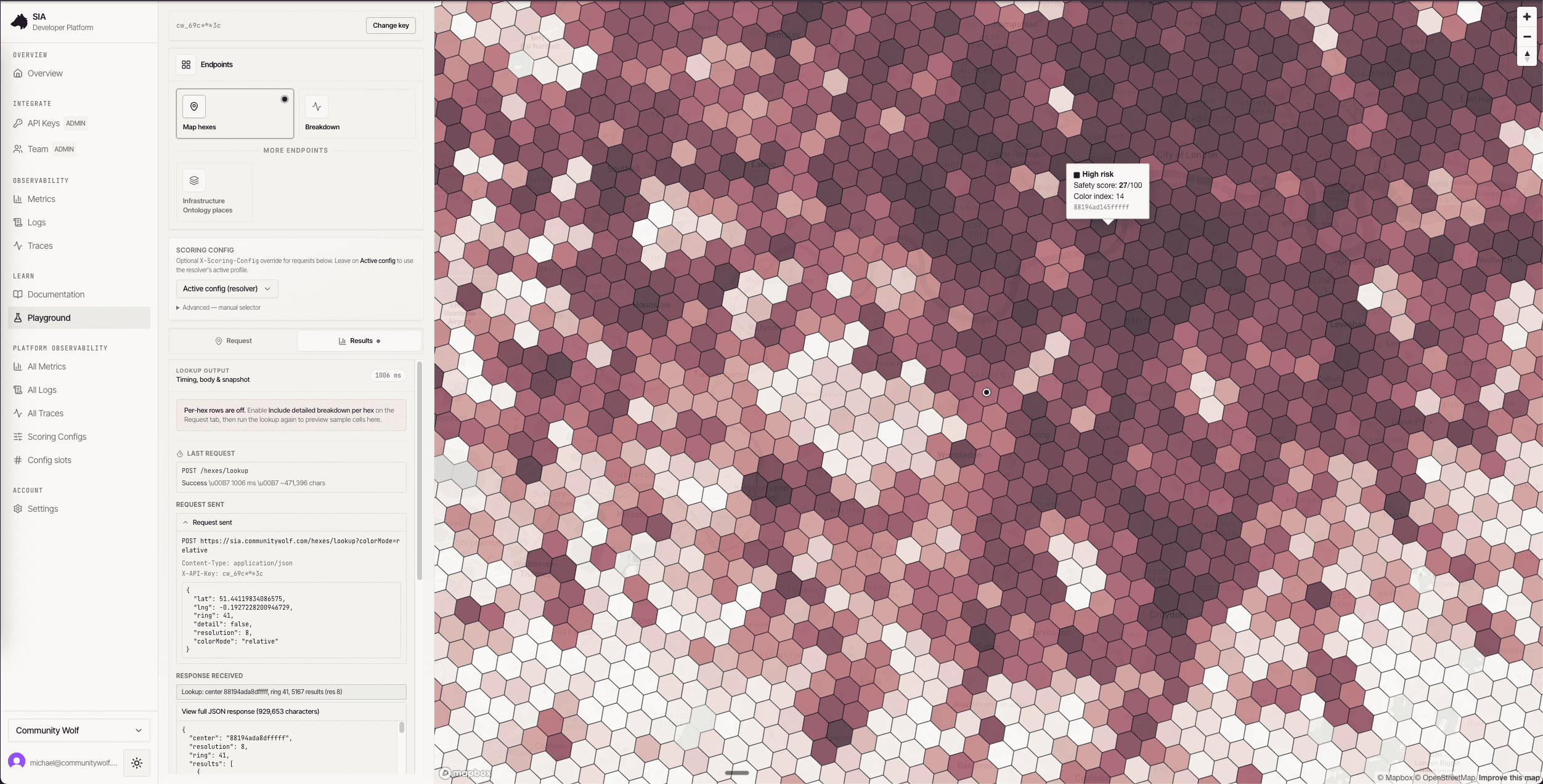
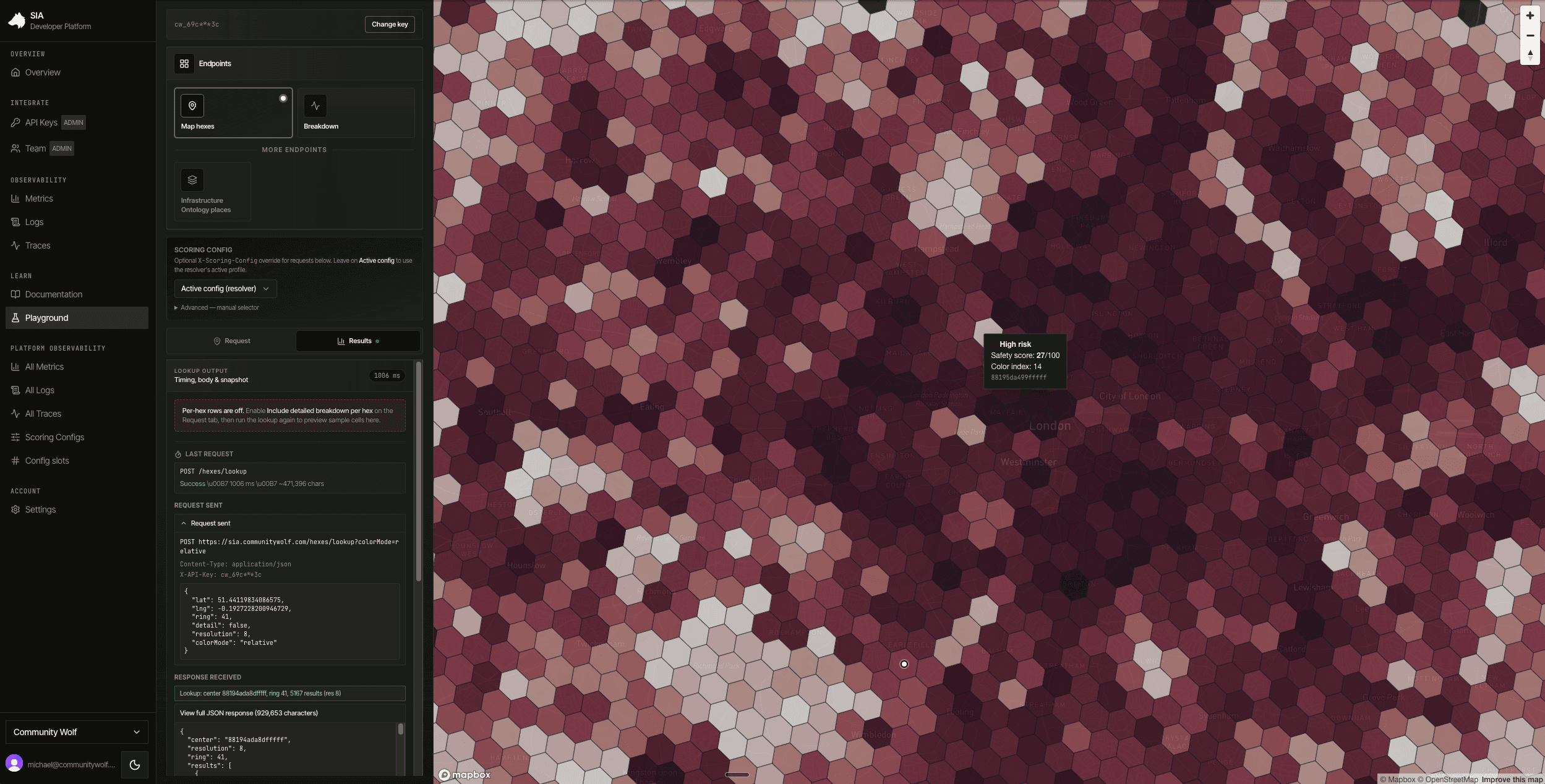
SIA does not pretend every country has the same data density. Each source is rolled up to the same hex mesh, then the Risk API composes the available sources for that place and intent. The theoretical basis is expanded on the research page.
Official and normalised incident patterns, grounded in crime-and-place theory, with precinct-level rollups where public data is less precise.
OpenStreetMap-derived places grouped by risk role: attractors, generators, defenders, convergence points and neutral context. This is how environmental criminology becomes usable infrastructure.
Observational data from the Community Wolf ecosystem, including portfolio applications, private partner feeds and community-submitted reports where they exist.
Survey and perception signals for day/night danger, environmental cues and fear-of-crime context.
A night-time walking risk question should not be weighted exactly like a long-term property investment question. SIA lets the caller request an intent, then returns the score and the source contribution that produced it.
If one source is thin or unavailable for a hex, SIA does not silently treat it as zero. The Risk API rebalances across the sources that are present and tells you which ones contributed.
That is the difference between a score you can display and a score you can defend. Product teams can use the number; underwriters, researchers and procurement teams can inspect the reasoning behind it.
{
  "h3": "881f1d4887fffff",
  "intent": "walk",
  "safetyScore": 72,
  "colorIndex": 10,
  "sourcesPresent": ["crime", "osm", "privateData"],
  "breakdown": {
    "crime": { "contribution": 0.42 },
    "osm": { "contribution": 0.31 },
    "privateData": { "contribution": 0.27 }
  }
}The default SIA model is useful out of the box. Regulated or high-volume teams often need their own posture: different crime-type weights, different source budgets, different intent profiles. That is why tunable models exist.
On Enterprise engagements, teams can save named, versioned model profiles on top of the same data layer. A profile can adjust source weights, built-environment risk classes, private-data factors and intent presets. Activation is atomic; changes are content-hashed and audit-trailed.
The principle is simple: customers do not have to buy our opinion of risk. They can use SIA as the safety-intelligence foundation and encode their own methodology on top.
We still publish what is coming, because product teams need to plan around it. We keep it separate from the live API surface so the page remains useful today and honest about what ships next.
The customer surface is small on purpose: production APIs, one toolkit, the CLI and MCP tools for agent workflows. The same partner key and schemas work across each surface, so teams can start in a terminal and move into production without integrating a second product. Browse the docs →
